For the past decade, crypto has been remarkably good at creating assets.
Bitcoin gave us digital money. Ethereum introduced programmable assets. Stablecoins brought dollars onchain. Now, Real-World Assets (RWAs) are bringing stocks, bonds, and funds into blockchain infrastructure, with over $39 billion in distributed asset value (RWA.xyz, September 2026).
Yet despite all that progress, one question remains:
Why is investing onchain still harder than it should be?
Think about how most people invest in crypto today.
If you're bullish on AI, you might buy RENDER, TAO, AKT, and a few infrastructure tokens. If you're bullish on tokenized U.S. equities, you may need to buy several individual assets separately, and every position has to be researched, purchased, rebalanced, and tracked on its own.
The blockchain makes ownership easy, but it doesn't necessarily make portfolio investing easy.
And that's the distinction.
The biggest financial product you've probably never thought about
When people hear "ETF," they often think it's just another stock market instrument. However, it is one of the most successful financial products ever created.
An ETF doesn't invent new assets. It packages existing assets into a single investable product. So, instead of buying 500 companies individually, you can buy one ETF that represents the entire S&P 500.
Easy.
Instead of researching dozens of gold miners, one ETF gives diversified exposure to the theme.
That simplicity changed investing as we know it.
The global ETF industry ended 2025 with $19.85 trillion in assets and a record $2.37 trillion of net inflows that year (ETFGI, January 2026).
That's one of the strongest adoption stories in modern finance.
Why did ETFs become so dominant?
Because they solved a simple problem: people don't want to build every portfolio from scratch.
Instead of buying 50 different stocks individually, an ETF lets someone buy one product that represents an entire strategy, sector, or index.
In this phase, the innovation wasn't the assets, but the wrapper.
Crypto has reached the same turning point
At Alloco we see the evolution of onchain finance happening in four stages:
Onchain Assets: crypto introduced native digital ownership.
Infrastructure: wallets and settlement became reliable.
RWA Onchain: real-world assets entered blockchain networks.
Product Wrapping: assets become structured, investable financial products.
We believe the first decade of crypto was about tokenizing things, and the next decade will be about structuring them.
We believe assets are ingredients, and products are meals.
Think about a supermarket.
Nobody walks in hoping to buy flour, sugar, butter and cocoa separately unless they're baking.
Most people simply buy a cake.
Financial markets work the same way.
Investors usually aren't looking for twelve individual companies. They're looking for exposure to ideas:
Artificial Intelligence
U.S. Energy
Stable Yield
Space Technology
Alloco ETFT aims to package those ideas into a single investable product rather than forcing users to assemble the basket themselves.
What is an onchain ETF (ETFT)?
An onchain ETF (ETFT) is an onchain investment product that packages multiple real-world or digital assets into a single tokenized portfolio, with a transparent basket, NAV-based valuation, and onchain mint and redeem mechanics.
An ETF gives investors exposure to a basket of assets through one product. An ETFT brings that same experience onchain: one token represents an entire investment strategy rather than a single asset.
That's the foundation of what we're building at Alloco.
Why this matters for RWAs
Tokenized stocks now total roughly $8 billion, but only about $2.5 billion of that can actually move between wallets; the rest stays locked inside the issuing platform (RWA.xyz, September 2026).
You can own tokenized shares of Company A or Company B, but building an institutional-quality portfolio still requires custody, valuation, compliance, rebalancing and execution.
The design of our ETFT model ensures that these functions exist at the product level, not the individual asset level.
Each ETFT can have its own basket, NAV, custody structure and compliance framework.
In other words:
That distinction is what makes our model interesting.
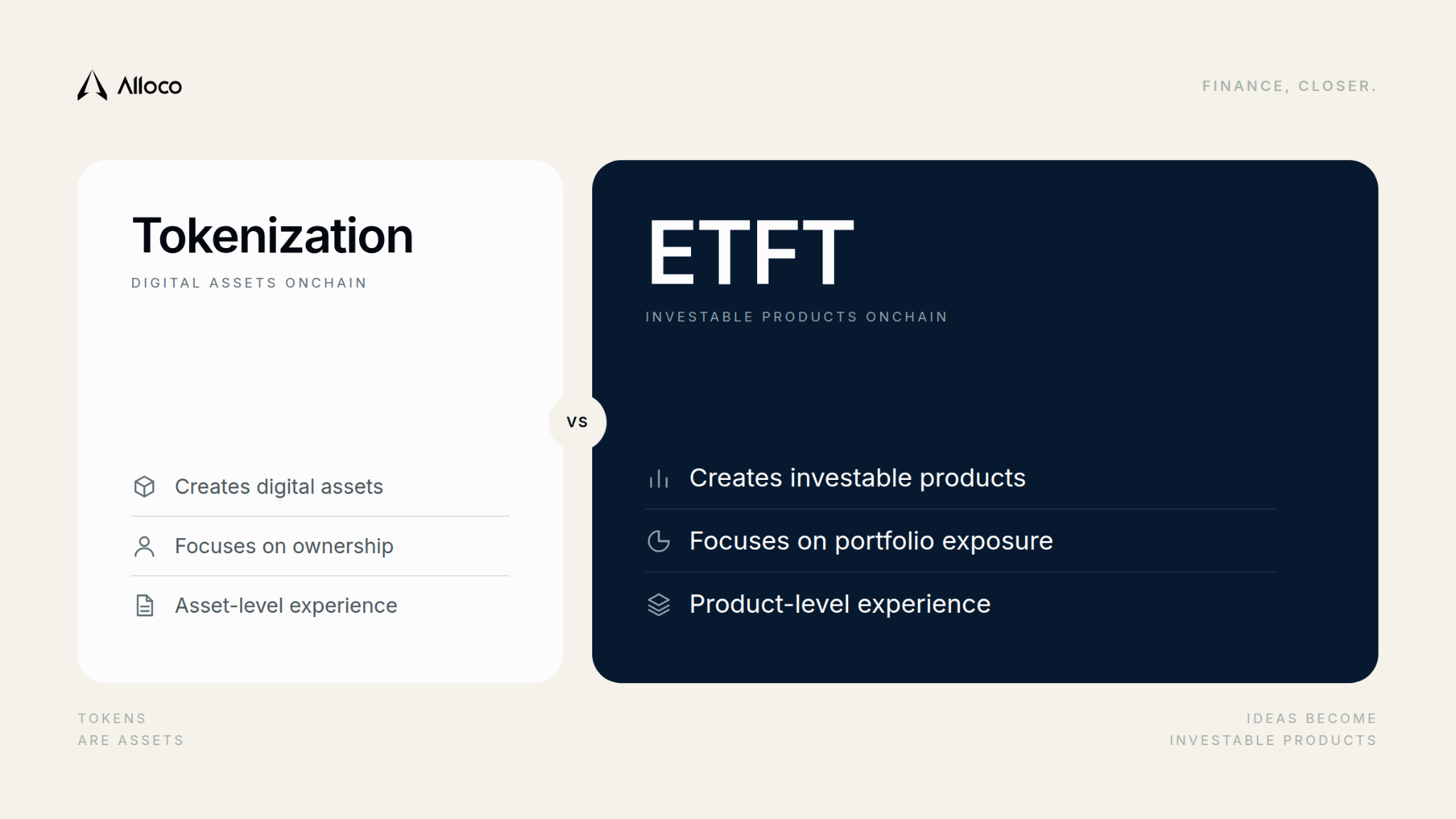 The real opportunity
Yes, RWAs are projected to bring trillions of dollars onchain. But their track record so far shows that assets alone don't create adoption.
Products do.
ETFs didn't become a $19+ trillion industry because stocks were new. They became successful because they made investing simpler, cheaper, and easier to access.
Onchain finance may now be approaching its equivalent moment, and we're building our ETFT to bridge that gap.
FAQ
What is the difference between an ETFT and a tokenized stock? A tokenized stock represents a single company. An ETFT represents a portfolio: a basket of multiple real-world or digital assets held as one token, with its own NAV, rebalancing rules and redemption mechanics. You hold the strategy, the ETFT holds the assets.
How is an ETFT valued? Each ETFT has a net asset value (NAV) calculated from the market value of the assets in its basket, divided by the tokens outstanding. Minting and redemption happen at NAV, so the token's value tracks the underlying portfolio.
Is an ETFT the same as a traditional ETF? No. A traditional ETF is a regulated fund listed on a stock exchange. An ETFT borrows the ETF's core idea, one product for an entire strategy, and delivers it as an onchain token with transparent holdings and onchain mint and redeem. It is a different legal and technical structure.
What can an ETFT hold? Any combination of tokenized real-world assets and digital assets that fits the product's strategy: tokenized equities, tokenized treasuries, crypto assets, or a mix. Each ETFT defines its own basket, allocation rules and rebalancing schedule.
About Alloco
Alloco is building an institutional onchain ETF (ETFT) issuance platform for global investors, standardizing institutional-grade assets, investment strategies and market opportunities to bring them onchain. Its product suite covers thematic asset baskets, hedge fund strategies, yield-generating products and tokenized Pre-IPO investments, delivered through three product lines: Earn, ETFT and Pre-IPO. Products offer real-time NAV, transparent holdings and onchain subscription and redemption.
Alloco is backed by YZi Labs and completed the fourth cohort of its EASY Residency program. The core team previously managed over $1 billion in institutional assets. Products are not available to residents of restricted jurisdictions, including the United States and Canada. Learn more at allocofi.com.